Children's book · ages 8 to 11, read-aloud from 6
The Brain Bandits™
Take back your focus. One mission at a time.
Paperback · 62 pages · Amazon.com
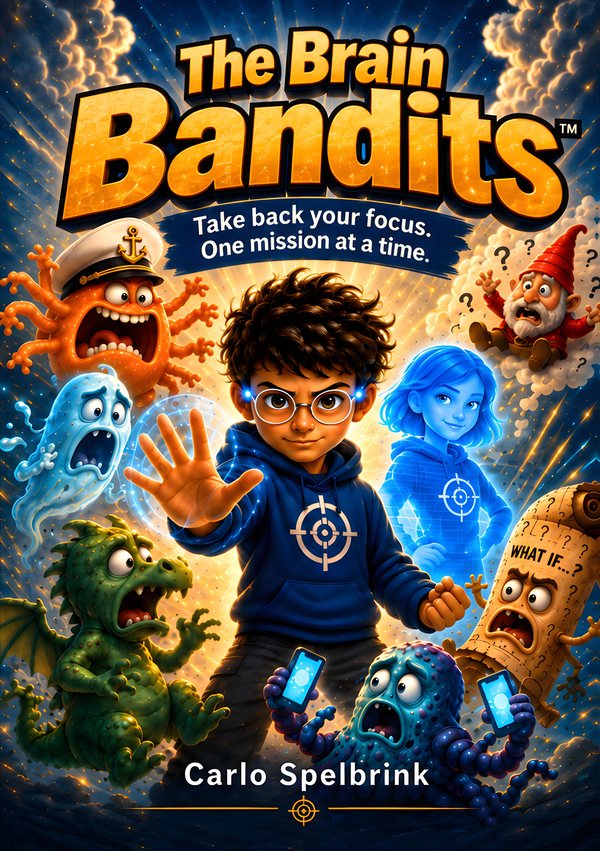
Some thieves steal your stuff. The Brain Bandits steal your attention.
Sam keeps getting distracted during homework, until one evening a mysterious pair of glasses turns up on the bed. With the Focus Glasses, Sam can suddenly see them: the Brain Bandits, sneaky little creatures that steal kids' attention. Captain Chaos. The Screen Kraken. The Doubt Scroll. And three more. Together with Agent Nova, Sam sets out on a mission to outsmart them one by one.
In this book, distraction isn't a flaw in the child. It's a gang of villains you learn to recognize and beat.
Free downloads
Nothing needs to be written in the book. Agent reports, villain scores, the agent card and the diploma all go in the Agent Logbook. Mission Pack #1 has new missions for after the adventure. Print both as often as you like, fresh for every child. No sign-up, no email address.
US Letter size. Printing on A4 works fine too.
What this book is based on
The Brain Bandits is a story, not a treatment. But the tricks Sam learns aren't made up. Each Brain Bandit stands for a familiar pitfall, and each trick draws on insights from developmental and motivational psychology. Here is what each part rests on.
Putting the villain outside the child
The whole book uses externalizing: the problem gets a name and a face, separate from the child. “I'm bad at paying attention” becomes “there's Captain Chaos again”. The approach comes from the narrative therapy of Michael White and David Epston and is widely used with children. Child and parent stand together against the problem, instead of against each other.
Captain Chaos · one thing on the table
Holding attention and getting started are executive functions: skills that are still growing in children and can be practiced. Whatever is within reach pulls at attention. Clearing away distractions before you start works better than willpower during the work.
The Memory Muncher · write it down and say it out loud
A child's working memory is small and loses information quickly. Writing something down right away gets it out of your head, and words you say out loud are remembered better than words you only read silently. Memory researchers call this the production effect.
The Someday Dragon · the first two minutes
Putting things off is rarely about laziness. A task feels too big, and starting is the highest hurdle. A tiny first step lowers that hurdle. Once you're going, you often keep going.
The Screen Kraken · focus session first, screen out of sight
A plan made in advance, in the form “if this happens, then I'll do that”, helps people stick to their intentions. It's called an implementation intention, and it is one of the best-researched techniques in motivational psychology. The book deliberately doesn't turn screen time into a reward, but into an agreement made at home. That fits the American Academy of Pediatrics' advice to make a Family Media Plan together.
The Racket Gnome · dump your thoughts on paper
Worries and busy thoughts take up space in working memory. Research with students showed that briefly writing down worries just before a test improved their scores. The book also asks children to tell a grown-up about anything that really scares or upsets them.
The Doubt Scroll · the word “yet”
“I can't do it yet” comes from Carol Dweck's work on the growth mindset: the idea that abilities can grow. We're honest about it. Large reviews show that the average effect on school results is small. So the book doesn't use it as a miracle cure, but as a way to see a mistake as a step rather than a verdict.
The motivation is chosen on purpose too
In the book, children choose when and in what order, and they earn XP for trying, not only for succeeding. That fits Ryan and Deci's self-determination theory: motivation grows when a child experiences autonomy, competence and connection.
What this book is not
Stand-alone “brain training” is no miracle cure: exercises mostly make you better at the exercises themselves, and that carries over to other tasks only to a limited extent. The strength of this book lies in the story, the repetition in daily life and a protected self-image. It is not therapy and not a diagnosis. If you are worried about a child's attention or development, talk to a doctor, a psychologist or the child's teacher. With a diagnosis such as ADHD, this book can be a light addition to professional support, never a replacement.
Sources
- American Academy of Pediatrics. Family Media Plan. HealthyChildren.org.
- Diamond, A. (2013). Executive functions. Annual Review of Psychology, 64, 135–168.
- Dweck, C. S. (2006). Mindset: The new psychology of success. New York: Random House.
- Gollwitzer, P. M. (1999). Implementation intentions: Strong effects of simple plans. American Psychologist, 54(7), 493–503.
- MacLeod, C. M., Gopie, N., Hourihan, K. L., Neary, K. R., & Ozubko, J. D. (2010). The production effect: Delineation of a phenomenon. Journal of Experimental Psychology: Learning, Memory, and Cognition, 36(3), 671–685.
- Melby-Lervåg, M., & Hulme, C. (2013). Is working memory training effective? A meta-analytic review. Developmental Psychology, 49(2), 270–291.
- Ramirez, G., & Beilock, S. L. (2011). Writing about testing worries boosts exam performance in the classroom. Science, 331(6014), 211–213.
- Ryan, R. M., & Deci, E. L. (2000). Self-determination theory and the facilitation of intrinsic motivation, social development, and well-being. American Psychologist, 55(1), 68–78.
- Sisk, V. F., Burgoyne, A. P., Sun, J., Butler, J. L., & Macnamara, B. N. (2018). To what extent and under which circumstances are growth mind-sets important to academic achievement? Two meta-analyses. Psychological Science, 29(4), 549–571.
- White, M., & Epston, D. (1990). Narrative means to therapeutic ends. New York: Norton.
The Brain Bandits was first published in Dutch as De Breinrovers. Illustrations are AI-generated from prompts by Carlo Spelbrink. See our disclaimer.